SKLN Counterflow Cooler

SKLN Counterflow Cooler Introduction

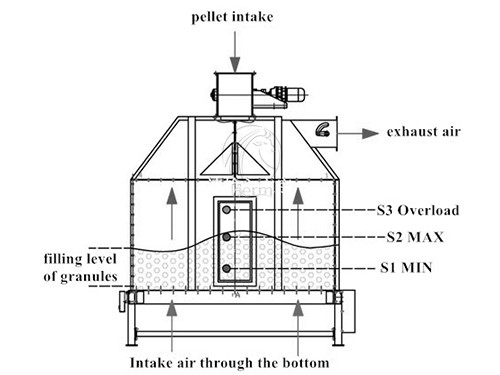
The cooling of pellets is an indispensable process in the granulation section. Our SKLN serious counterflow cooler is adopted to cool the pellets with high temperature and moisture. Hot air touches hot pellets and cool air touches cool pellets to avoid the pellet surface crack caused by sudden cooling produced by direct touching between cool air and hot pellets. The counterflow cooler can cool the pellets with a temperature of 70 ℃ -90 ℃ to a temperature slightly higher than the room temperature of 3 ℃ -5 ℃, and can be reduced to safe moisture (≤12.5%), which is convenient for pellet transportation and storage. The machine adopts a unique sliding valve mechanism to discharge materials, and the operation is smooth and the discharge is smooth.
pellet_feed_cooler_cost
pellet_feed_cooler_price
SKLN Counterflow Cooler Advantages


Uniform cooling

It is widely used in the feed and biomass processing industry to cool various granular materials.

Small footprint

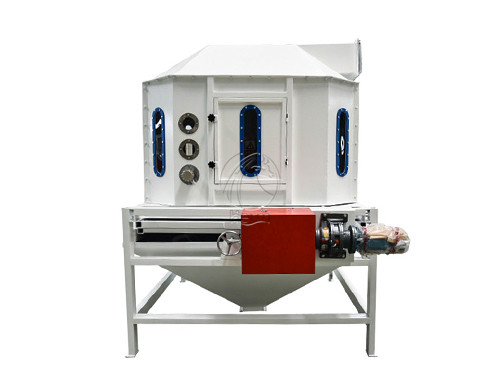
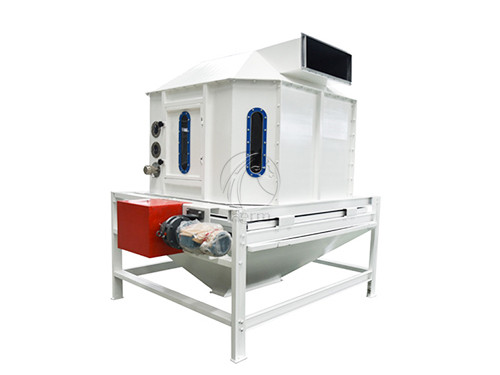
The vertical overall layout, compact structure, and small footprint.

Easy to maintain

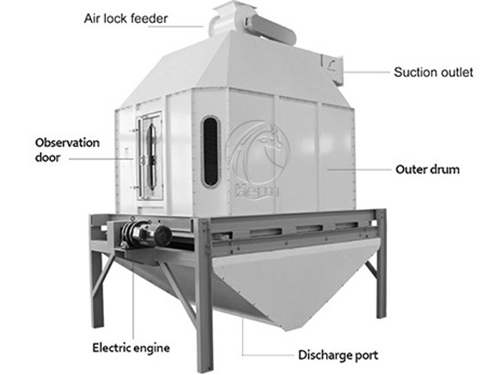
There is an inspection door on the front of the equipment, observation windows on the side, and a top cover, which are convenient for observation and inspection.

Long-lasting

The discharge pressure relief plate increases the working load, reduces deformation, and prolongs the life of parts.

Stable operation

The geared motor drives the eccentric shaft for transmission, which is stable and reliable, with low noise and easy installation and maintenance.

Unique design

The octagonal cooling bin prevents dead ends.
counterflow_feed_cooling_machine
counterflow_feed_cooler (1)

Comments

Popular posts from this blog

Ethiopia’s Animal Feed Market in 2024: Growth, Trends, and Opportunities for the Future

Ethiopia Animal Feed Market Analysis 2024: Trends, Challenges, and Opportunities With its immense agricultural potential, Ethiopia is one of Africa's fastest-growing economies. Agriculture, particularly livestock farming, is dominant in the country’s economic growth. The animal feed market in Ethiopia is a vital component of this expansion, driven by a growing demand for high-quality animal products, including meat, milk, and eggs. This article comprehensively analyzes the  2024 Ethiopian animal feed market , exploring the current trends, challenges, opportunities, and prospects. Market Overview With a population of over 120 million people,  Ethiopia’s livestock sector  is one of the largest in Africa, featuring cattle, sheep, goats, poultry, and camels. However, livestock productivity remains low, largely due to inadequate nutrition, poor management practices, and limited access to high-quality animal feed. The  animal feed industry  in Ethiopia is experie...

Is It Profitable To Invest In Feed Pellet Mill Line In Iran?

Is it profitable to invest in  a  feed pellet mill   line   in Iran? The answer is yes. Iran has major plans for modernising its domestic feed industry. Besides modernising the feed industry, Iran has set its sights on exporting large quantities of feed across the Middle East. Herm Machinery talked with Dr Majid Movafegh Ghadirly, Chairman of the Iran Feed Industry Association. What Is The Capacity Of Iran's Feed Production Per Year And What  Is Your Forecast For Production In 2030? “The established production capacity of Iran's animal feed industry is 21 million tonnes of production per annum. However, Iran’s actual production performance was around 11 million tonnes in 2019, 6.3 million tonnes of which was livestock feed, 4.2 million tonnes poultry feed and 400,000 tonnes aquaculture feed. Also, around 100,000 of feed was produced for other species such as camels, ostriches, turkeys, pets, etc. By 2030, population growth is expected to drive domestic feed dema...

5 7t feed processing machine